Invisible Technology: The Reliance we have on technology today.

Our objective for task one was to create a working application and pitch it to our tutors. The group decided to create a university application, allowing students on the same course to connect and introduce themselves prior to the course starting, taking inspiration from Unite Students, an application in the same field of motives but focusing on accommodation.  

This essay will aim to discuss invisible technologies, relating to media ecology suggesting ‘technology and techniques, modes of information and codes of communication play a leading role in human affairs’ (Gamaleri, G 2019). This essay will focus on the issues of big corporations such as Google and Facebook.  

 In today’s era, it seems as though technologies and societies are integrated in complex circuits of interactions and relationships that therefore makes it impossible to isolate from one another. We now push a lot of reliance onto technology, with Berners-Lee suggesting that the integration of connectivity and digital services would bring ‘the workings of society closer to the workings of our minds’ (2000: 6).  

By the end of 2011, almost half a billion ‘smartphones’ had been shipped in the world (MobiThinking, 2012). Scholars claim that ‘added to the previously purchased smartphones, this meant that there was a total of around 1.1 billion smartphones in use by the end of 2011’ (Bredican J and Vigar-Ellis, D 2014), suggesting the rise in technology was enormous and ever increasing, seen as an easier way to communicate with people as well as use these phones in their everyday routines. It’s proposed that people predominantly use social media to ‘communicate, look for events, notice stores and brands and find the weather. It’s how people are aided in their daily life’ (Loewen, J 2018). The development of more operating systems such as software, materials, mobile phones and applications themselves has enabled technology to be the driving force in today’s society, having a vast impact on our day to day lives, with ever-growing responsibilities and reliance on technology.  

A recent example of the reliance would be the likes of Google going offline, sparking an outrage from its users (Hern, A 2020). What should be noted is that the development in technology is shown with this issue, as not only did it affect people’s emails, it affected their living as well with people complaining on social media of ‘being unable to switch off some lights in their homes’ (Cellan-Jones, R. 2020). This shows how technology is no longer just applications for communicating, as earlier stated it is now a technique and a new way of living for the majority. This example is not the first, and potentially won’t be the last, as with technology comes the risk of systems crashing, most likely due to the number of users it faces.  

Furthermore, people are considered above all as consumers and the ‘markets’. ‘People believe that fast is better than slow, that new is better than old, that more is better than less; and, if people can’t get this, then they are forced to rethink the meaning of the word ‘better’(Gamaleri, G 2019), representing that people expect the best due to promotion from companies offering no less than this, then leading to an outrage when a system goes down.  
 

As much as technology development is convenient, there are some examples of how ‘technology is making our minds redundant’ (Foer, F 2017). His example was Facebook deceives their users without them knowing due to the invisibility of this technology. Foer expresses that ‘Facebook is always surveilling users, always auditing them, using them as lab rats in its behavioral experiments’ (2017).  

This suggests that Facebook creates the impression of free will when using their application, when it actually ‘paternalistically nudges users in the direction it deems best for them, which also happens to be the direction that gets them thoroughly addicted’ (Foer, F 2017).This expresses the idea of Facebook tactically using the rise of social media to their advantage in order to have more users on their social media. It begs the question of if they are wanting users to use the application for themselves, or if Facebook is in fact using it for their own advantages. However, Annette Baier argued that trust can only exist in relationships where there is a possibility for betrayal, and that we cannot truly form trust relationships with technology because technology cannot “betray” us in the exact sense of the word (Baier, 1986). Technology does disappoint us but does not betray us like people do, suggesting people will still continue to use these technologies as they see the problems as an easy fix.  

In conclusion, invisible technologies are socially depended on, with the majority of people taking them for granted due to the ease of them. As much as they have glitches, our world is now digital. Due to us not seeing this technology, it could be considered that technology owns us, rather than us owning technology, therefore reiterating an earlier point of Facebook making it’s consumers vulnerable. Technology may no longer be seen as a way to enhance intelligence, but a trend we buy into, and will continue to buy into as it develops for centuries to come.

REFERENCES 

Media Technologies: Prototype

Description of prototype: 

When told about the group project at hand, the group wanted to focus on something original yet beneficial. We thought to focus on an application connecting students to one another through an application, therefore creating and developing the idea of ‘UniLink.’ Our application aims to give an opportunity to get students to talk to one another throughout their university experiences, working as one and helping each other with struggles they have.

Market Research 

After deciding on an idea completely, I prepared a survey to send out to people to gain market research as this was my main focus of the project. This aspect of creating a prototype is vital, enabling you to gain information and tips from people within your target audience, as well as others simply giving advice. I used an application familiar to me from previous university years called Survey Monkey, which allows you to create your questions from scratch and send to people through a hyperlink.

We had 16 respondents, who were asked their age and if they were a student previously or presently. Furthermore, questions such as ‘do you deem this app to be useful?’, as well as ‘would you use it?’ were asked, thus helping us determine if our app would be worth it for our target audience. Questions asked lead to answers helping to define what should be included in the application and what they’d expect to see. With answers then provided, a database was made in order for us to be organised with our work, in which Elisabeth focused on in order for everything to work together and be a success. 

The survey was aimed towards students both past and present, and our selected age range was 18-25 with the majority of students being in this age group. Most of the respondents deemed this application to be a well thought idea. We were advised to have chat rooms as well as an anonymity feature for those who don’t want to be visible but still want to participate. Most respondents also said they would use our application! This therefore solidifies why our application would be beneficial, because if people in our target audience see this to be something useful, our reach could be high for many other students, especially if we were to make our application international. A link to our presentation can be found here, where I talk about the survey results in depth: 

This application will include ways in which you can engage in both group work and activities, as well as get to know your course mates before you begin university. Inspired by personal experiences, the application would be an ice breaker to help students when making friends. Making an application where you’re making it easier for others is something our group wanted to do!

Design

Paige’s focus was on designing and creating the application, which you can read more into with the link at the bottom of this page. We all discussed the colour theme and what would grab people’s attention which is why we went for a bold red, as well as a simplistic logo to show what our application has to offer straight away. As well as this, the application was made to fit the brands image, using the same colour scheme as before. This way, students can easily identify UniLink just through our chosen colours as they’re quite unique for a study application. Not only this, the colour choice won’t distract them as we wanted to keep it simple for this reason. The overall layout is simple. An over complicated layout could make our application appear clumsy rather than helpful for our users. How it works is your university log in connects you directly to your course with that specific log in, therefore leading to an easy set up and connecting you almost instantly.

Technical features

The discussion was made on what was to be included after the market research was submitted. Phoebe focused on what to include for the applications technical features which is linked at the bottom of this blog. Technical features therefore help people to use the application, making it a lot more self explanatory than complicated for students when logging in. One feature to point out is the profile feature. This enables students to be creative with their own page, choosing an image of their choice to represent themselves. There is also, as previously mentioned, the option for anonymity. However, you still have control of how your own profile looks even when using this feature of the application. This therefore emphasises the control and the freedom students are given within our application, and makes it a lot more fun to use for them.

There’s a definite gap in the market for this application, with only a handful of applications dedicated to university students. With a major reliance on technology nowadays, UniLink helps students to keep in contact with one another regardless of the circumstances. This can help both students and the university to get the best possible experience without having the face-to-face interactions as we want students and lecturers to communicate about group work, upcoming deadlines and just general talks to develop friendships.  

Why do we need this application?

Our application is relevant to today’s society. As much as Facebook groups can be created for specific courses, these can be confusing as the majority of the time people are mixed into courses that aren’t necessarily their own. Why not have a specified application that helps to find your own course and people who you will be spending the next 3 years learning from and learning with. 

With our future development, we hope to branch to international rather than just Sheffield, helping thousands of students with their learning. We also discussed partnership with Blackboard rather than seeing them as a competitor and be a chain in Sheffield Hallam’s helpful applications. 

Please refer to my groups individual work for more information: 

Paige Kay: design, creation and growth of the app: Uni Link – My Media Blog (home.blog)

Phoebe Rowlands: Tetrad, technical features and affordances: https://phoebesmedia.home.blog/2020/11/26/blog-post-1-prototype-description/

Elisabeth Salter: Database and data policieshttps://mediablog695284194.wordpress.com/2020/11/28/our-app-unilink-media-technologies/

Dissertation Proposal

‘Separating the art from the artist’.
Aiming to discover whether artists accused of misogyny and abuse in their real lives reflect these attitudes in their art.’


I am wanting to explore the background of R Kelly and how his actions could be reflected in his music. I can also relate this back to the ‘Surviving R Kelly’ documentary, as well as the #MeToo and #MuteRKelly campaigns. As well as this, I will want to touch on the efforts to help the survivors, why it took so long for people to believe the survivor’s accusations, relating this to race especially.

Methods I will use will be surveys, aimed specifically at 20-28-year old’s, as this is the predominant age range to listen to RnB artists. If possible, I will also form a focus group to discuss this statement above, see what people make of it, to what extent they agree or disagree with it and also ask the question of if they still listen to R Kelly.

After researching to find references, it seems there’s plenty of material I can look at in helping me to answer my statement. Many people have spoken out about R Kelly, explaining ways in which this man had managed to keep his high profile even after their scandals were uncovered, taking 20+ years for his career to finally be haltered and true self noticed by the public. There are also articles I will touch upon which talk about the scandals themselves and how they happened, therefore allowing me to understand the issue at hand. Academically, there aren’t many texts out there on this topic, so may take a bit more time and research to find my literature and sources for him. However, there are plenty of articles and journalistic quotes I can use. Not only this, I will also use literature that talks about the analyzation of popular music to therefore give me evidence as to why RnB music is popular in general. This therefore gives me the background I need to structure my dissertation.

REFERENCES:

Arnett, J. J. (2002). The sounds of sex: Sex in teens’ music and music videos. Sexual teens, sexual media: Investigating media’s influence on adolescent sexuality, 253-264.

Brassett, J. (2009). British irony, global justice: a pragmatic reading of Chris Brown, Banksy and Ricky Gervais. Review of International Studies, 35(1), 219-245.Eldridge, A. (2020).

Chris Brown | Biography, Songs, Controversy, & Facts. Encyclopedia Britannica. Retrieved 27April 2020, from https://www.britannica.com/biography/Chris-Brown.

Fischer, P., & Greitemeyer, T. (2006). Music and aggression: The impact of sexual-aggressive song lyrics on aggression-related thoughts, emotions, and behavior toward the same and the opposite sex. Personality and Social Psychology Bulletin, 32(9), 1165-1176

Fritch, C. C. (2017). Chris Brown: Out of control mess or grossly misunderstood Artist?. The Review: A Journal of Undergraduate Student Research, 18(1), 6.

Machin, D. (2010). Analyzing Popular Music: image, sound, text. (pp. 1-12). London: SAGE M

Roberts, D.F, & Hendricksen, L. (1990). Music listening versus television watching among older adolescents. Paper presented at the annual meeting of the International Communication Association,Dublin, Ireland.

Roberts, R., & Christenson, P. (1997). It’s not only rock and roll: Popular music in the lives of adolescents.

Rothman, E. F., Nagaswaran, A., Johnson, R. M., Adams, K. M., Scrivens, J., & Baughman, A. (2012). US tabloid magazine coverage of a celebrity dating abuse incident: Rihanna and Chris Brown. Journal of health communication, 17(6), 733-744.

Media Technologies: Personal Reflection.

Personal Reflection 

Creating an application was a unique and fun experience, challenging both me and my group to think outside the box and be creative with it.  I am proud to say I’m happy with how the work turned out, grateful to have the skills I didn’t have before. 

Challenges and Difficulties

When it comes to challenges I do feel the task had quite a few. One difficulty was having to do this group work online as opposed to being able to go into university to do it. It was a lot harder to arrange meetings, as my technology at home was not ideal. My laptop would often crash and not let me connect to the zoom calls. I did want to be able to work on the application with Paige but due to this issue of online working, we decided it would be better to have one person do this, therefore leaving me feeling like I hadn’t contributed much to the team. I feel I struggled with explaining why our application is beneficial and better than competitors as I find it hard to criticise applications I deem to be successful so this may have hindered the presentation as I didn’t mention our inspiration of Unite Students because I didn’t see this to be beneficial to our work, however looking back I feel I should’ve mentioned this in the presentation. Lastly, the essay part of the assignment was the main struggle for me. I found it difficult to find a topic I was comfortable talking about and applying it to the module itself, so it did take a couple of attempts as well as a few emails to my peers for help before feeling confident about it!

Achievements
I believe my market audience and my research was an achievement as a whole, as I was happy to learn what we needed to include for our work in order for it to be successful. I feel I asked the right questions as well as targeted the right people when I formed my survey. Survey Monkey is potentially one of my strengths. I have used this website since I started university and have grown to like it, therefore enabling a successful and understandable survey for people to answer. Not only this, I feel I did well when answering the feedback questions, telling my mentors the reasons why I personally felt this application needed to be a real working prototype. I ensured them the success of this app would come naturally, as students like me prefer interacting with one another before meeting as it performs as an ice breaker for us all and helps with comfortability. 

Despite times where I did feel like the work I had done wasn’t beneficial or helping by any means, I did come to realise that market research is one of the main aspects of the whole project. Having the realisation that my work was important and was vast help for my team made me feel a lot more confident in what I’d done and what I’d achieved. I’m happy I kept going with the work and made it the best it could be. Overall, I’m proud of myself, what I’ve learnt during media technologies and what I have achieved and know for a fact these skills will help in the future, with whichever career path I take!

MIR BP6 – Appendix

Alreck, P. L., Settle, R. B., & Belch, M. A. (1982). Who responds to” gendered” ads, and how? Masculine brands versus feminine brands. Journal of Advertising Research.
Attwood, F., & Lockyer, S. (2009). Controversial Images: An Introduction. Popular Communication, 7(1), 1–6. https://doi.org/10.1080/15405700802598411
Ballaster, R. (1991). Women’s worlds : ideology, femininity and the woman’s magazine . Macmillan.
Blue-Collar Workers. (2016, Sep 20). Retrieved from https://studymoose.com/blue-collar-workers-essay
David M. Potter, People of Plenty: Economic Abundance and the AmC1¡ican Character (Chicago: The University of Chicago Press, 1954), p. 188.
Davidson, Gina. 2004. Sites to check out if you chav what it takes. The Edinburgh Evening News, : 14 4 Feb.
Davtayan-Gevorgyan, A. (2016). Women and Mass Media | Feminism and Gender Democracy. Retrieved 1 January 2020, from http://feminism-boell.org/en/2016/04/08/women-and-mass-media
Durham, M., & Kellner, D. (2001). Media and cultural studies : keyworks . Malden, MA: Blackwell Publishers.
Elliott, R., Eccles, S., & Hodgson, M. (1993). Re-coding gender representations: Women, cleaning products, and advertising’s “New Man. Retrieved 1 January 2020, from https://www.sciencedirect.com/science/article/pii/016781169390013O
Elliott, R., Eccles, S., & Hodgson, M. (2007). International abstracts of research in marketing. International Journal Of Research In Marketing, 24(4), 350-359. doi: 10.1016/j.ijresmar.2007.09.005
Engeln-Maddox, R., Miller, S. A., & Doyle, D. M. (2011). Tests of objectification theory in gay, lesbian, and heterosexual community samples: Mixed evidence for proposed pathways. Sex Roles, 65(7-8), 518-532.
Freeman, J. (1984). The distorting image. Amherst: University of Massachusetts Amherst.
George, J., & Uhlenbrock, M. (2010). EFFECTS OF ADVERTISEMENTS ON PERCEPTIONS OF WOMEN’S LEADERSHIP. Retrieved 1 January 2020, from https://psych.hanover.edu/research/thesis10/uhlenbrock%20and%20george%20is%20final.pdf
Goldman, R. (1992). Reading ads socially . Routledge.
Grusky, n. (2003). The Impacts of Social Class | Boundless Sociology. Retrieved 1 January 2020, from https://courses.lumenlearning.com/boundless-sociology/chapter/the-impacts-of-social-class/
Kilbourne, J. (2009). Beauty…and the Beast of Advertising | Center for Media Literacy | Empowerment through Education | CML MediaLit Kit ™ |. Retrieved 1 January 2020, from http://www.medialit.org/reading-room/beautyand-beast-advertising
Kuhn, A. (2004). The State of Film and Media Feminism. Signs, 30(1), 1221-1229. doi:10.1086/422233
McRobbie, A. (2009). The Aftermath of Feminism : Gender, Culture and Social Change. Los Angeles ;: SAGE.
Miller, William. 1997. The Anatomy of Disgust, Cambridge, MA: Harvard University Press
Norval, E. (2011). Research into Women’s Magazines and the Social Construction of Womanhood. Institute Of Communications. Retrieved from https://pvac-webhost2.leeds.ac.uk/ics/files/2011/12/Emily-Norval1.pdf
Roy, A. (1998). Images of Domesticity and Motherhood in Indian Television Commercials: A Critical Study. Journal of Popular Culture, 32(3), 117–134. https://doi.org/10.1111/j.0022-3840.1998.3203_117.x
Winship, J. (1987) Inside Women’s Magazines. Pandora: London
Women: The moving target in the UK J. Walter Thompson, London (1986)

Celebrity culture- fans and audience

Over many years, celebrities have dominated the news, as well as featuring on several TV shows, radio shows and many more. Dyer and Cashmore note that ‘every celebrity has their own persona; they bring different ideas or ideologies. (Dyer, 1979; Cashmore, 2014) Celebrity culture is now reflected in social norms and values due to the extreme citizen involvement and is seen as a form of escapism from reality. Through this, fan bases are formed, and in this essay, it’ll be discussed as to why people become heavily involved with certain celebrities, and the focus will be One Direction. ‘Stars and celebrities are consumed and appropriated by fans in ways which have a profound effect on their identity, self-image and sense of belonging.’(Redmond, S. & Holmes, S 2007) which is one point as to why fans and audience are important when it comes to celebrities.
One Direction were an incredibly popular boyband, formed by Simon Cowell on The X Factor series 7. They didn’t win yet have since been one of the biggest boybands in the world. They have now split up and become solo artists. One main reason for their success was the fandom that was created after their debut on X Factor, with several people creating fan accounts on Twitter, Instagram, and even fan fiction blogs. Soukup states ‘via the identification processes associated with fan sites, fans can significantly influence the meanings, uses and even production/distribution of media texts and manipulate the complex iconography of celebrities to ‘visibly’ participate in public discourse’ (Soukup, 2006:320). This means that fans can manipulate the way celebrities are to fit their fantasy, which can mainly be done through fan fiction.
Fan fiction is potentially the most popular for ‘Directioners’, with many writing stories that fulfil their fantasies and how they wish the celebrity to be. ‘The creative process allows the pop slasher to construct the star as a recreation of the stars supposedly ‘real self’. Moreover, pop slashers refuse to follow the cliché of declaring the public performances of pop stars a fiction and the band members fake and fabricated, instead their stories often reveal deep empathy and sympathy for the stars they depict’ (Busse, 2006:256). This suggests that fans defend the celebrities they support in every situation as they want the best for them and are constantly viewing their profiles to be up to date with everything they’re doing, which therefore helps them build a persona or a story for their next fan fiction. This can however be controversial, with some fan fictions creating rumors or discomforting stories, such as ‘Larry Stylinson’.
Fans of former boyband One Direction (“Directioners”) have often been represented in media discourse as obsessive and hysterical, with fan behavior interpreted as longing for heterosexual intimacy with band members. Subverting this heteronormative framing, a group of Directioners known as “Larries” have built a sub-fandom around imagining a relationship (“ship”) between two of the band members, Harry Styles and Louis Tomlinson. (McCann, H & Southerton, C. 2019) Larry Stylinson was a fan name created, mixing the names of Harry Styles and Louis Tomlinson as a ‘ship name’, where fans were guessing these two were a couple due to how they acted on stage. This ship name became insanely popular amongst one direction fans, with drawings being made, as well as several fan fictions, escalating to the point where Louis Tomlinson tweeted saying this was the ‘biggest load of bullshit’, (Twitter, 2012) therefore reinforcing the idea that some fan fictions can be uncomfortable for the celebrities, especially when these stories are implying your sexuality. When addressed by Louis, a new hashtag trended saying ‘#RIPLarryStylinson’ showing how invested people can become with fan fictions. As much as fans aren’t meaning any harm by what they’re doing, there’s loads of people talking about the sexuality of two younger men, which therefore creates a media spectacle for several news companies, meaning articles are published with so-called rumors about Harry and Louis, which they’ve not confirmed or denied.
An incredibly successful fan fiction is Amanda Todd’s ‘After’, a blog about Harry Styles being a mysterious boy falling in love with a girl called Tessa. Since publishing, she’s had over 800 million reads, and ‘the 25-year-old just scored a six-figure advance’ (Daily Mail 2014) due to the success of the Wattpad posts. Since then, it’s been made into a film on Netflix, as well as more to follow. This suggests it’s possible to become a ‘big name fan’, in which you become well-known for producing something to do with another celebrity. Todd has been successful due to her consistency and dedication to her Wattpad, so now she’s always to be known as the girl who made these books, follow-ups and films happen. (Jenkins 2006 a/b)
Due to the vast fan club One Direction have, a documentary was made about it, showing how people have merchandise, as well as posters on the wall. It also shows the extremities fans go to in order to meet their icons. In the program, it showed fans following the boys up to their room to see where they were staying or waiting outside the hotel until they left. This reinforces the fact that certain fans are ‘othered’: presented as devious, dangerous, vulnerable, irrational’ (Jensen, 1992). Some fans take it too far at times, and forget to realize that these people are real, and may see it as being stalkerish when fans are following them home. It also draws attention to the obsessiveness some fans feel towards celebrities and feel emotionally invested in these people so much that they try extremely hard to be in their personal lives. This shows the problems with fandom.
As well as this, online fandom is seen to be a problem too. When talking about stalkers, Moffatt states ‘you can imagine how much I hate them… it’s only fans who do this, or they call themselves fans.’ (Moffatt, S) This can be seen with the film ‘After’, as many fans were quick to exclaim how they already knew the story. Due to fans being so invested in celebrities’ lives, they may feel obliged to let everyone know the story of the film, therefore ruining it for many. They may want to address that they knew about the fan fiction before the film to portray themselves as ultimate fans. This therefore ruins it for others, who may not class themselves as fans, just an audience who want to see the film.
In conclusion, fans help in creating a vast success for many stars, allowing them to be adored, as well as giving them the publicity they need to remain relevant. One Direction has been built on a huge fan base that continues today, as many hope for a reunion to happen for the One Direction men. Yet fans can also be excessive with their celebrities, forgetting they have a side of their life they wish to keep private, reiterating how fans are borderline intrusive to their lives. However, it’s also an investment that these fans have dedicated many years building on, either in fandoms, social media accounts or following the One Direction members.
REFERENCES
Busse, K. (2006) My Life is a WIP on my LJ: Slashing the Slasher and the Reality of Celebrity and Internet Performances. In: Hellekson, K. and Busse, K. (eds) Fan Fiction and Fan Communities in the age of the Internet. London: McFarland and co.
Dyer, R. (2013). Heavenly bodies: Film stars and society. Routledge.
Jenkins, H. (2006a) Convergence Culture. London: New York University Press.
Jenkins, H. (2006b) Fans, Bloggers, Gamers: Exploring Participatory Culture. London: New York University Press.
Jensen, J. (1992) Fandom as Pathology. In Lewis, L (ed) The Adoring Audience: Fan Culture and Popular Media. London: Routledge.
Peppers, M. (2014). One Direction fan lands SIX-FIGURE book deal for fantasy fiction. Retrieved 6 January 2020, from https://www.dailymail.co.uk/femail/article-2662647/One-Direction-fan-lands-SIX-FIGURE-book-deal-online-fantasy-fiction-boy-band-attracts-800million-reads.html
Redmond, S., & Holmes, S. (Eds.). (2007). Stardom and celebrity: A reader. Sage.
Soukup, C. (2006) Hitching a Ride on a Star: Celebrity, Fandom, and Identification on the World Wide Web. Southern Communication Journal 71 (4): 319-337.
Tomlinson, L. (2012). Twitter. Retrieved 6 January 2020, from https://twitter.com/louis_tomlinson/status/247381724760264704

MIR BP5: Evaluation and conclusion.

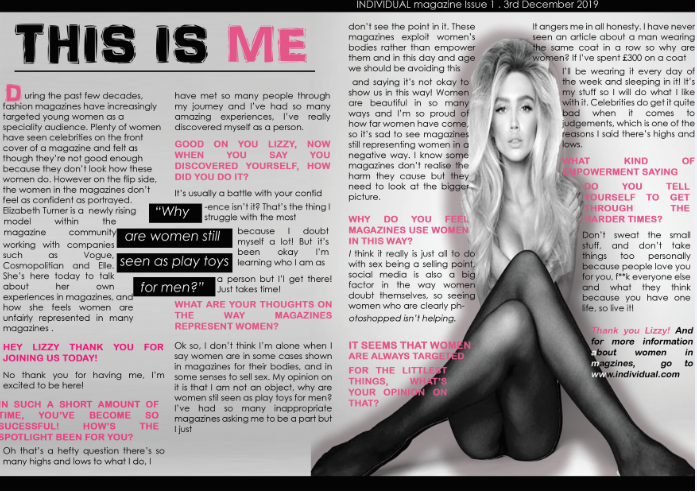
I enjoyed creating my double page spread as it was a creative task that allowed me to do independent work and show the skills that I have with software. I believe my interview was successful and the magazine looks professional. It was very time consuming however, so I am glad I managed my time well on this particular task. I enjoyed how I was able to make it my own and stand out from what’s already on the market, as well as designing it all myself through drawings. (Attached to my appendix). I was also able to get someone’s opinion on the way women are portrayed in magazines as well, which gave an insight to how she as a rising star model felt.
Textual analysis was intriguing as I was able to compare a few adverts for social classes and gender which also linked to theorists in my literature review. I also created a survey featuring eight questions, asking people anonymously how they felt about gender in adverts as I wanted to find out how people felt about gender roles as well as the LGBTQ+ community. If I was to do it again, I would also make time to do a questionnaire for social class as I’d then have plenty of evidence to back my research. I may also make my analysis more specific, focusing on a certain brand or even a portrayal of social class in TV shows. Having said this, I am still glad I chose the topic I did because I have found out a lot of things I didn’t know before through the research I did.
This project has taught me that times are changing, as there are less stereotypes nowadays about women being a stay-at-home mum and dad’s being breadwinners. Not only this, it’s shown how proud people are to be themselves, we are becoming a lot more accepting and diverse which has been great to explore when researching into my topics. I’ve also learnt, more technically, how to use certain software, developing my skills as well as learning new ones. I believe media is a vast topic with so many elements, so I enjoyed finding more out about it. As well as this, there’s never a right answer and media is usually dependant on opinions most of the time, apart from news we hear on the radio or TV.

MIR BP4: Production Diary.

FRONT COVERdps.PNG

I created a front cover and double page spread based on someone’s opinion on how women are represented in magazines, using an influencer on a smaller scale who understands the common ways women are shown on front covers or just in magazines in general. Understandably, print magazines aren’t as popular as they once were due to internet development, so if my magazine was to be published, I would choose to have it as an online magazine just for the purpose of gaining more reads through the internet rather than people buying it in the shops.
I chose to do a magazine as I feel very comfortable with the software used to create it, as well as magazines being my focus for the interview, so it fits the brief well. I was going to use images where my model was a lot more covered up but decided these ones show a lot more vulnerability and fit my topic well. I wanted to have a trendy looking magazine that differs from many others already out there.
I decided to overlap my text as well at the top just to highlight the title, as I wanted to portray the idea that women are independent and strong and shouldn’t be seen the way they are in most magazines. I also used three images of the girl to symbolise women coming together as one and to represent the focus of this magazine will be women. For my double page spread, I took a lot of inspiration from magazines such as Bazaar and Cosmopolitan, where they have one main image and text surrounding it. This is because it looks clean and has enough text space when doing an interview. I also decided to do an interview as these can be very interesting, and with my model being an Instagram influencer, some people may know her and want to know her views on the topic discussed. I did however include more than one photo when I first did the production as I felt as though one wasn’t enough, but when I changed the layout it ended up looking better with one black and white photo.

Linking back to my literature review, Goldman (1992) suggests that advertising in magazines is a main social and economic institution that pursues to uphold cultural hegemony by providing us socially constricted ways of seeing and making sense of society. I wanted to challenge this with my magazine and show that women should be so much more than being pretty and should be shown for their intelligence as well as their strength and courage. I also wanted to challenge Campbell and Carilli’s theory of ‘women play a crucial role in advertising. It encourages women to see themselves as ‘merchandises’ as an object.’ (2005) This is because my interview is stating that times are changing, and women should no longer be objectified. Also, these theories were written a while ago now so may not be of any relevance as such anymore, especially seen as print magazines aren’t as popular as they once were.

Image result for hayley williams double page spreadScreen-Shot-2013-01-17-at-09.59.00-copy
If I was to redo my production work, I would perhaps include more than one interview or include a second double page spread to show a variety of opinions, or maybe interview a man and see where his opinions differ.

MIR BP3: Critical analysis

Critical analysis of advertisements representing social classes and gender.
I’ll be analysing how different classes are represented in advertisement, that being either print adverts or TV adverts. I will also incorporate the representation of gender in them as well. The first UK advertisement was on TV on 22nd September 1955, made by AB-Pathe, it was a 70 second ad for Gibbs SR Toothpaste, and since then most channels use these to break up a show.
Advertisements are incredibly popular to promote a product a company wants to sell and is a great technique to persuade people to buy. It also populates a company, especially those not as well known as others. Kilbourne states “ads sell values, images, concepts, success of worth, love and sexuality, popularity and normalcy. They tell us who we are and who we should be. Sometimes they sell addictions’ (Kilbourne, Beauty and the Beast). This is evident in straplines some companies use for example L’Oreal uses ‘Because you’re worth it’ directing the statement towards the audience and makes them feel as though they’re deserving of this product.
Advertisements, while are a good selling point, are predominantly stereotypical when it comes to social class. For example, if you were to see an expensive dress in a print advert, it would most likely appear in Vogue (a typically upper-middle/upper class magazine) with a glamorous model, contrasting to a print advert you’d see in an Aldi print advert, regarded as appealing to the lower-middle class or working class audience.

Image result for dior jennifer lawrence
https://www.youtube.com/watch?v=1CRihg1X89A : When looking for adverts to compare, I decided that a perfume advert would be best to analyse the portrayal of upper class. For starters, Dior has a stigma attached of it being very expensive and, in some cases, unaffordable to many. In this advert, it shows a well-known actress in her own villa surrounded by sea and pools. This represents the wealth she has and what the perfume wants you to feel when wearing. It attaches wealth with owning your own villas or going on expensive holidays. The actress is also wearing expensive jewellery which can also show how wealthy she is. After much research, I haven’t found any perfumes that represent the working class, instead focusing on actors or actresses and the wealth they portray. This could be a selling point for many companies as celebrity branding entices custom, as well as gets promotions on other platforms from the celebrity involved. This can also be known as celebrity branding, a heavily used technique to ‘boost brand awareness’ and ‘enhancing credibility and gaining visibility for brands. (Elkins, H. 2019). Furthermore, celebrity branding can build credibility for smaller businesses and can expose a brand to new markets. Due to the increase in use of social media, celebrity advertisement has become vast in sales. This is because a celebrity promoting a brand a consumer is inspired by trusts the product, as well as a lot of consumers wanting to own a product a celebrity has used or has been the face of. The upper class is therefore represented in a lot of the perfume advertisements to have a label of elegance and sophistication.

Image result for KFC one big family ad
https://www.youtube.com/watch?v=1QjJAAMU4sA : This can be contrasted to an advert such as fast food adverts. One example I found was the KFC ‘one big family’ advert. In the advert, it can be seen that ‘dad figures’ are attaching random tables together in a small garden to eat as a big family. This is representing the working class more than the perfume ad above because it consistently shows the reality of working-class families, with unkept gardens and your typical semi-detached houses rather than a big villa with a private pool. The dads could stereotypically be classed as ‘blue collar’ workers, defined as employees performing manual labour generally, their jobs entail physical labour, such as in factories or workshops. This contrasts to a so-called ‘white-collar’ job in which belongs to a class of employees known for earning higher average salaries doing highly skilled work, but not by performing manual labour at their jobs. White collar jobs are usually considered as the upper-middle class jobs, due to a suit having connotations of importance so it’s no surprise that stereotypically this is the case.
See the source imageA print advert that received a vast amount of complaints was Protein World’s ‘are you beach body ready?’, featuring a photo of a slim model in a small bikini, as well as the weight loss pills collection they were promoting. The ad suggests that people reading are not in shape like the model in the advert is, and then follows up with a photo of the weight loss pills as if to say consumers need to buy these for them to be ready for summer. While this doesn’t necessarily connect with social class, it does with gender. This advert received many complaints due to the objectification of women and addressing how women should look. Referring to my literature review, Carilli and Campbell (2005) argue women play a crucial role in advertising. It encourages women to see themselves as ‘merchandises’ as an object. This links to the advert as the model is selling an image and making people feel as though they need to look like this. It defines this body image to be the norm rather than showing diversity for all body types.
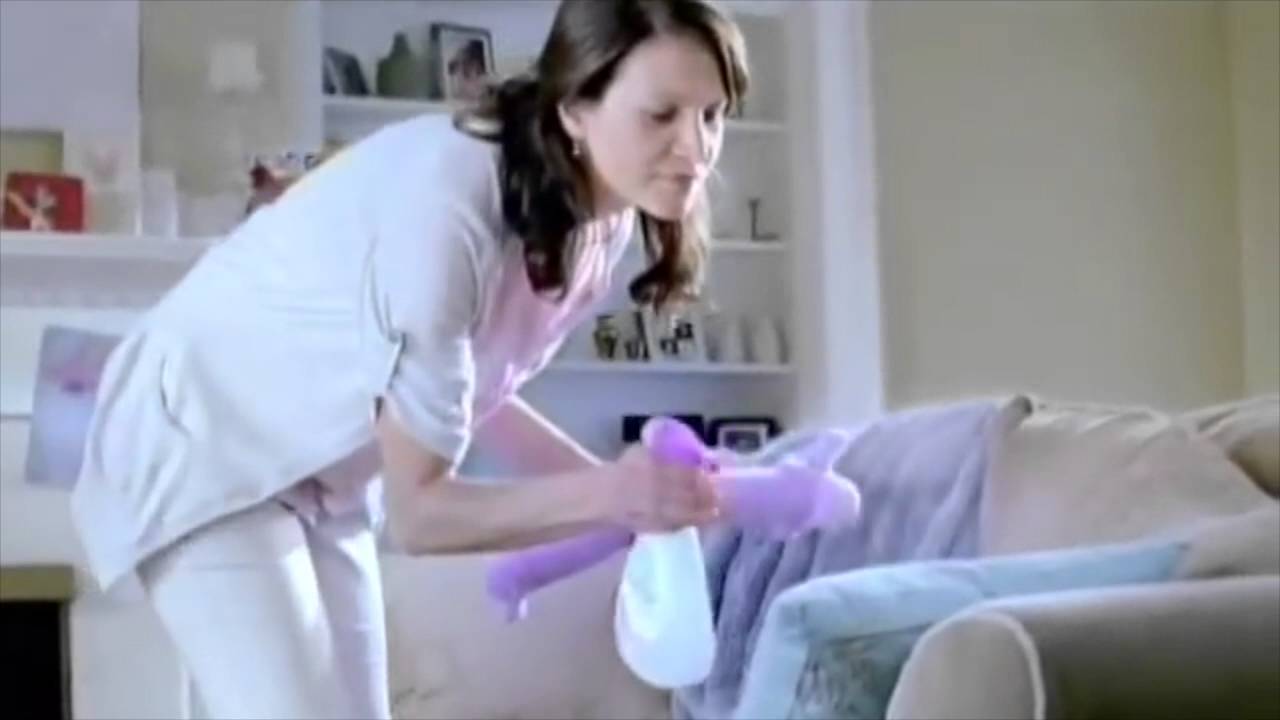
See the source imageSee the source imageSee the source imageWomen are also represented as stay at home mums in multiple cleaning adverts, such as the ones shown above. Flick (1987) states ‘advertisements only give a partial view of women, and that they feature women in stereotyped situations’ (Flick, 1987). Furthermore, the Advertising Standards Authority performed some research, finding 35% of women in 1990 were “deeply concerned with the way women are portrayed in advertising.” This concern was also found in the research covering TV advertising by J. Walter Thompson (1986), which found women to be particularly critical of advertisements for cleaning products which “exaggerate the importance of household chores or suggest that house- wives are only (or especially) concerned with getting things cleaner, whiter, softer, or fresher.” Also, these cleaning adverts represent the working class a lot more than they would upper class due to the stereotype of rich people having their own cleaners rather than doing it themselves.

I also did some of my own research  by doing a survey to see anonymous opinions on gender and advertising. Below are my questions and answers received.

The answers given shown how times have predominantly changed as people are a lot more accepting of the LGBTQ+ community, but will still stay traditional which is shown in my last question. As well as this, men answering my question about portraying men in adverts as stereotypically women roles mainly said they felt negative towards this, perhaps suggesting it tests their masculinity and challenges the typical gender norms.

Celebrity Culture – Essay 1 (Scandal and Confession).

Scandal and confession are a huge part of celebrity culture that is particularly damaging for star image and can directly affect a celebrity’s career and their associations depending on the issues. The example of confession within recent celebrity culture I’ll be exploring is Khloe Kardashian’s break up with Tristan Thompson, focusing mainly on Jordyn Woods’ confession of the drama on Red Table Talk on 1st March 2019 and the outcomes of the scandal afterwards.
Jordyn Woods is best known as being the Youngest Billionaire’s (Kylie Jenner) best friend. In terms of media specifically, Woods would be an ‘ascribed celebrity’ (Rojek, 2001). Rojek explains there’s three types of celebrity, ‘ascribed meaning ‘famous through family connections’. Due to Woods being as close to the Kardashian/Jenners as she once was, she was given loads of opportunities, as well as Kylie Jenner naming products after her. One of the most obvious opportunities the Kardashian’s gave her was allowing her to star on the popular TV series ‘Keeping Up with The Kardashians’, currently on season 17 with the possibility of more to come. The scandal episode was shown on this said series, which aired on 24th June 2019 on E! Khloe exclaimed on the show that Jordyn Woods and Tristan Thompson ‘both collectively ruined your relationship with me, with your daughter and with Kylie.’ (Buzzfeed 2019). Leading on from this, ‘Television presents ‘personality’. The personality is someone famous for being famous. In some ways, TV personalities are the opposite of stars, agreeable voids rather than sites of conflicting meanings.’ (Ellis, 1982: 107). Jordyn Woods was given a huge platform through someone else, and because of the show, she’s predominantly known as someone more successful best friend.
During the Red Table Talk interview, Jordyn Woods admitted to the scandal, As Dyer says, ‘all we know is what we see and hear before us’ (2004. p65). This could suggest that Jordyn may have said the things she did to put herself in a better position, to clear her name yet make herself look like more of the victim with the backlash she’s had, with many internet users calling her a ‘slut’. The interview was posted on Facebook Watch, viewed by 7.5 million people in 23 hours (Metro 2019). This represents how she could be wanting sympathy for what’s happened to her, and she knew by appearing on a TV show, many people would watch due to their interest with the famous family and anything that happens within it. Yet Dyer’s perception could also be that Jordyn Woods had no choice but to appear on TV because her star image had already been tainted by the scandal. The drama still seems to be ongoing, with an article about the interview being released 23 hours ago (viewed 27th November 2019), still discussing whether Jordyn Woods seems genuine with what happened and her actions.
The Red Table Talk may have helped Jordyn Woods redeem herself, as Redmond suggests celebrities use the role of confession, perhaps in a public speech leading to an apologetic approach. ‘Stars and celebrities confess, and with doing so confirm their status as truthful, emotive, experimental beings who, as devotional fans, we can invest in’ (Redmond 2008: 109-110). This is shown in her interview as the first clip of Jordyn Woods for the interview is her crying, whilst the interviewer, Jada Pinkett Smith, explains how Jordyn Woods was the one who reached out to her to get her ‘story heard’ (Red Table Talk 2019), reinforcing how Jordyn Woods wants to clear her name and move on from the scandal now.
Before an official statement was released about the cheating scandal, many articles already speculated that something had happened due to the rumours raised. Due to technology rapidly developing, ‘the speed and cause of effect has increased, fuelling the time sensitive response from those who commodity reputations to protect’ (Hanukov, 2015). Media sources can get a slight insight to the scandalous story and exploit a celebrity before the people involved address anything. Yet after the confession Jordyn Woods made, the media was quick to respond with headlines referring to Tristan Thompson as a love-rat, yet still calling Jordyn Kylie’s best friend (Daily Mail, 2019). This reflects on how Jordyn Woods is mainly known with this label. Furthermore, Rowbottom (2013) suggests the idea of ‘naming and shaming’, to punish informally a named individual as well as to ‘criticise and express disapproval of them’. Media, however, do more than name and shame, they effectively enforce their view through the power of publicity (Rowbottom, 2013: 15). This could potentially be a reason as to why there was so much coverage, everyone had a huge opinion on the scandal so there were multiple articles written about Jordyn Woods and Tristan Thompson. As much as these articles inform, they’re also considered as ‘infotainment’, as everyone was following the story at the time, so news articles may have added in slight untruths to make their stories seem a lot more interesting.
Lastly, when scandals occur with celebrities, endorsement deals can be cut. Jordyn Woods has been removed from all business deals with the Kardashians, as well as no longer starring in the family TV show. However, the focus was on how many family and friends she’d lost due to the scandal. As well as this, Jordyn Woods was said to feel ‘relieved to have not lost her make up endorsement deal’ with Eyelure lashes and was said to be her main concern. (Boren, J. 2019) This relates to Cashmore, who discusses ‘scandals that once killed careers can now boost them’, as Jordyn Woods is still very much in the limelight regardless of what happened. (Cashmore, E. 2014)
Overall, scandals and confessions play roles in celebrity culture and how a star image is shaped. In this instance, it showed Jordyn Woods to be a celebrity with a lot to lose, and which she risked. Yet being in the limelight was no help for this. From the interview she took part in, Jordyn Woods was able to show her authenticity. The use of this term in celebrity studies, as established by Dyer’s work, has suggested that we are encouraged to locate the ‘real’, ‘true’, ‘private’ stars away from their public persona (Dyer, 1979). From the interview, she showed she is in fact human, she’s made an awful mistake but now she wants to move on from this and be seen as her own person, rather than someone that’s been hiding behind the Kardashian/Jenner’s for many years. Scandals are dangerous for celebrities to be a part of, they can either make or break you, and if they break you, the media has shown you’ve got to work hard to clear your name and grow from it.

REFERENCE LIST
Boren, J. (2019). Jordyn Woods Forgets Tristan Thompson Scandal in Slinky Mini in London. Retrieved 5 January 2020, from https://hollywoodlife.com/2019/03/25/jordyn-woods-slinky-gold-mini-dress-london-photos-eylure-collection/
Cashmore, E. (2014). Celebrity culture. Routledge.
Dyer, R. (2003). A Star is Born and the Construction of Authenticity. In Stardom (pp. 155-163). Routledge.
Hanukov, I. (2015). Exposing Celebrity Scandal: How Journalism, Fame, and Audiences Coincide (Doctoral dissertation, Concordia University).
Holmes, S., & Redmond, S. (2007). Stardom and celebrity: a reader. Los Angeles; SAGE.
Kitch, C. (2006). Pages from the past (pp. p65-66). [United States]: The University of North Carolina Press.
Ojamu, N. (2020). Jada Pinkett-Smith on why she let Jordyn Woods’ appear on Red Table Talk | Metro News. Retrieved 5 January 2020, from https://metro.co.uk/2019/08/02/jada-pinkett-smith-confirms-jordyn-woods-happy-got-tell-truth-tristan-thompson-cheating-scandal-red-table-talk-10508500/
Parker, H. (2019). Khloe Kardashian shows love rat Tristan what he’s missing as she models bustier with jeans… after stating she is not ready to date again. Retrieved 5 January 2020, from https://www.dailymail.co.uk/tvshowbiz/article-7278229/Khloe-Kardashian-shows-love-rat-Tristan-Thompson-hes-missing.html
Rojek, C. (2001). Celebrity. London: Reaktion.
Rojek, C. (2012). Fame attack: the inflation of celebrity and its consequences. London: Bloomsbury Academic.
Rojek, C. (2014). Niccolo Machiavelli, cultural intermediaries and the category of achieved celebrity. Celebrity Studies, 5(4), 455–468. https://doi.org/10.1080/19392397.2014.923163
Rowbottom, J. (2013). To punish, inform, and criticise: the goals of naming and shaming. Media and public shaming: Drawing the boundaries of disclosure, 1-18.
Stice, J. (2020). 7 Celebrities Who Lost Major Endorsement Deals. Retrieved 5 January 2017, from https://www.mentalfloss.com/article/94882/7-celebrities-who-lost-major-endorsement-deals
Woodward, E. (2019). The Tristan/Jordyn Cheating Episode Of “KUWTK” Aired and We Finally Know All the Shocking Details. [online] BuzzFeed. Available at: https://www.buzzfeed.com/elliewoodward/khloe-tristan-jordyn-cheating-scandal-episode-kuwtk [Accessed 5 Jan. 2020].

Design a site like this with WordPress.com
Get started